
We provide below an overview of the social and environmental impact of pearls, how it can be measured, managed and valued.
We also highlight the importance of developing a universal approach and language to bridge pearls and their impact as they always reflect the journey of the mollusc they grew within.
Our purpose here is to inform and inspire the sector by engaging the whole pearl value chain towards better practices.
Principles
Sustainability can be defined as meeting the needs of today’s generation without compromising the ability of future generations to meet their needs (UN Brundtland Commission 1987).
It is underpinned by the three pillars of environment, social and governance (ESG) that supports sustainability’s key principle of balancing economic growth with environmental and social protection. This is sometimes also called the triple bottom line -people, profit and planet- describing the impact of an organisation beyond its financial performance.
The Food and Agriculture Organization of the United Nations (FAO) further elaborated in its 2025 Guidelines for Sustainable Aquaculture (GSA) that efforts to attain animal health, welfare, and viability in aquaculture can be achieved through governance frameworks and strategies that are tailored to local, national, or regional contexts, and that are climate-smart, socially, economically, and environmentally sound.
While still having room for improvement and not dwelling on past practices, both natural and cultured pearls are uniquely positioned amongst gems to eventually become and profess sustainability as part of their appreciation alongside beauty, rarity and durability.
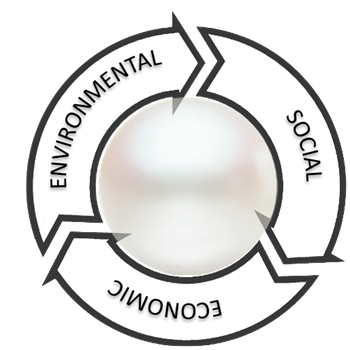
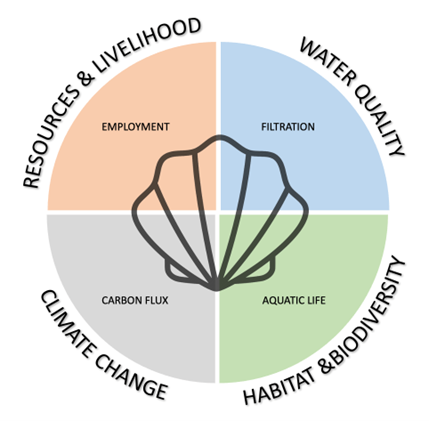
Mollusc driven Impact
Molluscs and pearl products generate value for communities (employment), impact climate (carbon capture and release), affect biodiversity (abundance and diversity), and mitigate pollution (water filtration). With this in mind, and while recognising room for overall improvement, natural and cultured pearls are inherently sustainable gems.
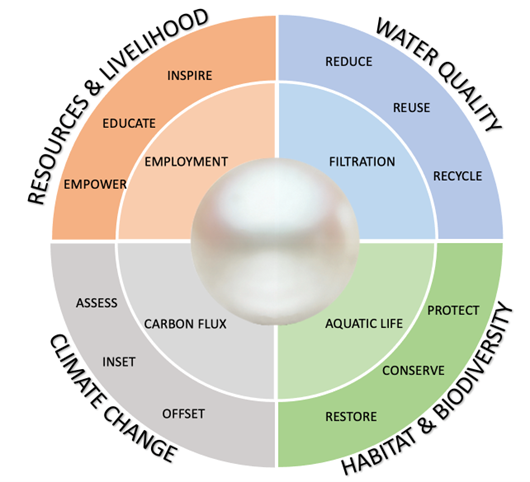
Pearler and pearl farmer driven impact
The entire journey of an oyster is recorded within layers of nacre and reflected by the virtues/ value factors of the natural and cultured pearl(s). There is a clear incentive for farmers/natural pearl fishers to further amplify the oyster benefits to communities and ecosystems as it customarily results in better quality pearls that improve the economic benefits to the farmers and fishers.
The journey from Corporate Social Responsibility (CSR) to Environmental, Social and Governance (ESG).
Most sustainability frameworks and standards are anchored on the Sustainable Development Goals (SDGs) adopted by the United Nations in September 2015 as part of the 2030 Agenda for Sustainable Development, with a target year of 2030 to achieve these 17 interconnected goals for ending poverty, protecting the planet, and ensuring prosperity for all.
CSR is an internal framework of a company's values and responsible culture, whereas ESG is an external, measurable assessment of a company's performance in specific areas of sustainability.
| Feature | CSR | ESG |
| Audiance | Internal (employees) and Consumers | External (investors, regulators, stakeholders) |
| Purpose | Value-driven, ethical obligation, philanthropic actions, and public image | Data-driven, risk management, long-term value creation, and access to capital |
| Nature | Voluntary and self-regulated | Increasingly mandatory, driven by external regulations and market standards |
| Measurement | Often qualitative, focused on goals and initiatives (e.g., community impact) | Quantitative and data-intensive, using specific metrics and key performance indicators |
| Scope | Broad and flexible, encompasses a company's general ethical obligations | Specific and standardized, focused on three core pillars: Environmental, Social, and Governance |
| Reporting | Less standardized, often descriptive and tailored by the company | Highly structured, follows internationally recognized frameworks (e.g., GRI, SASB) |
ESG standards provide the tools and metrics to drive investment towards organisation using natural resources responsibly. Performance measurement and management usually deliver productivity gains and can drive cost reduction. Systematic improvements monitoring can efficiently support storytelling and contribute to opening new markets.